



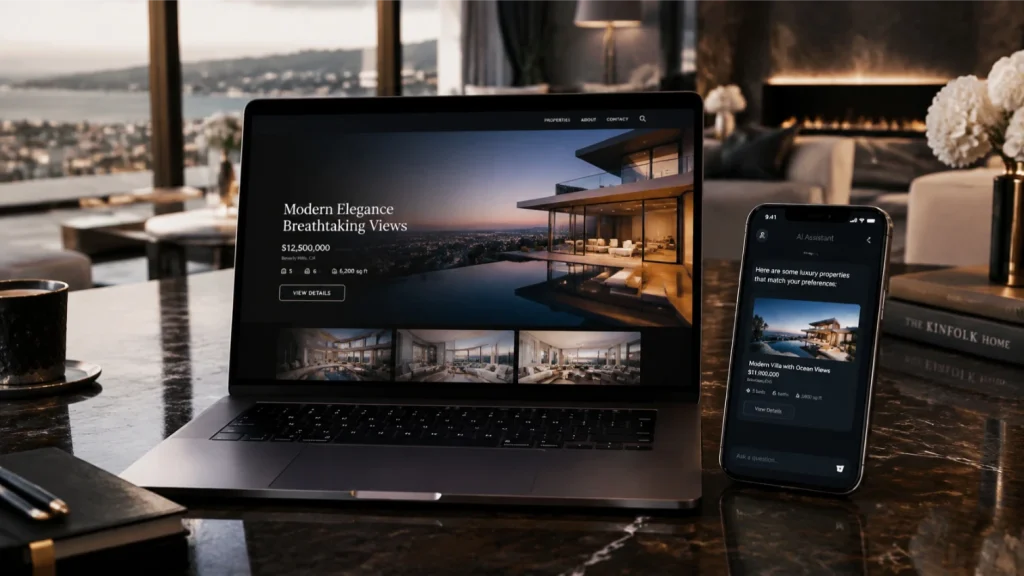
Mostly through search, and largely through the same pages. In NAR’s 2025 buyer survey, 52% of buyers found the home they purchased online. AI assistants such as ChatGPT, Google’s AI Overviews and Perplexity draw on pages their search crawlers can reach. LR Media Group’s advice: make every listing page complete, crawlable and accurate.
Where do buyers start their home search?
Online, for most of them. The National Association of Realtors’ 2025 Profile of Home Buyers and Sellers, covering purchases from July 2024 to June 2025, found that 46% of buyers began by looking at properties online. Another 20% began by contacting an agent. By the end of the search, 52% had found the home they bought on the internet and 27% through an agent.
The agent still matters: 88% of buyers purchased through a real estate agent or broker, and the median search lasted 10 weeks. These figures cover all buyers, not only the luxury segment, so treat them as a baseline. They show that the listing page is usually where a buyer’s first impression forms.
What do buyers want to see on a listing page?
Pictures first, then facts. In the same NAR survey, 81% of buyers rated photos as very useful on real estate websites, and 77% said the same of detailed property information. Floor plans were rated very useful by 57%, and virtual tours by 38%.
For a luxury listing, that points to a short list. Use real professional photography of the actual home, not stock images or unlabeled renderings. Publish the specifications as text: bedrooms, baths, interior and outdoor space, lot, parking, building amenities, taxes and fees. Add a floor plan wherever the seller allows it. A buyer comparing several homes at the same price will rarely chase missing details; many will simply move on to a listing that answers their questions.
How do AI assistants find a listing?
Through crawlers and search indexes, much like a search engine. Google says there are no special requirements for its AI Overviews or AI Mode: a page needs to be indexed and eligible to show in Search with a snippet. OpenAI says its OAI-SearchBot surfaces sites in ChatGPT’s search features, and sites that opt out of it will not appear in ChatGPT search answers.
Perplexity uses PerplexityBot to link websites in its results, and Anthropic uses Claude-SearchBot to index content for Claude’s search responses. OpenAI, Perplexity and Anthropic each describe search crawling separately from AI training. OpenAI, for example, says its GPTBot training crawler and its search crawler are controlled independently, so a site can opt out of training and still appear in search.
What makes a listing page easy for both to understand?
Clear text, consistent facts and a page that is easy to reach. Google’s guidance for its AI features lists the basics: important content in text form, structured data that matches the visible text, supporting images and video, a good page experience and internal links that make the page easy to find. It also says site owners do not need new machine-readable files, AI text files or special markup.
In practice, keep the price, address, status and contact details identical across the website, MLS and social posts, and update them the day they change. Put key facts in the page text rather than only in images or PDF brochures. Link each listing from related pages, such as a neighborhood guide or development page.
What should brokers check before a listing page goes live?
Run a short technical check with the web team. Confirm that robots.txt and any firewall or bot-protection settings do not block the search crawlers of Google, Bing, OpenAI, Perplexity and Anthropic, unless that is a deliberate decision. Make sure the page is not set to noindex or nosnippet by mistake.
Then use Google Search Console’s URL Inspection tool and Bing Webmaster Tools to confirm the page can be crawled and indexed. After launch, set a reminder to update or remove the page when the listing goes under contract or the price changes. An assistant quoting an old price on an active listing is a poor first impression, and the fix starts with the page itself.
Frequently asked questions
Google says no new machine-readable files, AI text files or special markup are needed to appear in AI Overviews or AI Mode. For ChatGPT search, OpenAI says a site needs to allow its OAI-SearchBot crawler to appear in search answers.
Not necessarily, because OpenAI and Anthropic each list their training crawlers separately from their search crawlers. OpenAI says the settings are independent, so a site can block GPTBot and still allow OAI-SearchBot.
No. Being crawlable and indexed makes a page eligible, but each assistant decides which sources to show for each question.
Market a luxury listing with LR Media Group
Learn what LR Media Group offers brokers and developers.
Explore LR Media Group services